

The Position of the Orthodox Eastern Church
An Orthodox Priest's response to the American Episcopal Church's theologians
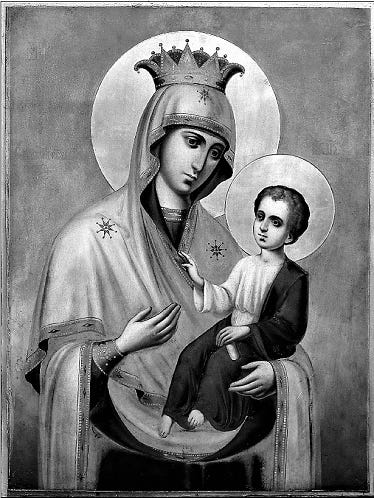
The Position of the Orthodox Eastern Church
by
Very Rev. Sebastian Dabovich, Dean of the N.A.E. Consistory, etc.
Publisher’s Preface
The Position of the Orthodox Eastern Church was originally published in The Living Church, a religious magazine based out of Milwaukee, Wisconsin, focusing on news and religious topics relating to the Episcopal Church and the Anglican communion at large. During the 20th century, dialogue opened between the Orthodox Church and the Anglicans, with the sincere hope of entering into mutual communion. Saint Sebastian was among several Orthodox saints to take part in this dialogue. From his communications, one can see his sincere hope for union among all Christians, yet remained steadfast and firm in defense of Orthodox dogma and belief, maintaining that certain agreements would have to be made for such a communion to be possible.
The Position of the Orthodox Eastern Church was in response to an article by Rev. Francis J. Hall, an American Episcopalian priest and theologian, with whom Saint Sebastian had exchanged private correspondence. Hall penned an article titled The Church and the East, detailing the issues in which Saint Sebastian laid out which inhibit mutual communion. To Hall, he writes, “Our Bishops and school representatives declare that the Episcopal and Anglican Church as a whole, i.e., as a Church, does not fully accept (1) the Seven Ecumenical Councils; (2) the Seven Sacraments; (3) the Doctrine of Transubstantiation; (4) [Allows] too much liberty, or abuse of freedom, in personal interpretation of the Bible; (5) the majority refuse spiritual aid unto the faithful departed and spiritual consolation unto the living, inasmuch as they reject prayers for the dead; (6) the majority have strong aversion to reverence shown and due the saints glorified; (7) Pictures and articles for uplifting and strengthening religion are rejected… I do not mention the Filioque, as… it is not known in early Christendom.”
In a later letter he calls attention to the English coronation oath, which the King takes “in the capacity of the Head of the Church and her defender,’’ etc. He says, that this oath “shocks the religious feeling of our people,” because of its language concerning the Transubstantiation, and its “referring to the invocation of the Blessed Virgin as idolatry.”1
As The Church and the East details the Episcopal doctrine, Saint Sebastian’s article is an Orthodox response, which those of the Anglican or broader Protestant communities may find enlightening in detailing their differences with the Orthodox faith, with appropriate explanation.
While genuine dialogue between the theologians of both churches took place for several decades, no rapprochement could be made concerning doctrine, and dialogue broke down starting in the 1970’s with the Anglican communion’s regular ordination of women. Unfortunately, despite the efforts in the 20th century, eventual communion with the Anglicans is much less likely today than it was during the times of Saint Sebastian and other Orthodox saints.
This is a digital edition of Beacon from the Bay: The Collected Works of Saint Sebastian Dabovich of Jackson and San Francisco, a several-month-long project to catalogue the out-of-print works of Saint Sebastian Dabovich, the first American-born Orthodox priest.
If you would like to purchase print copies of Beacon from the Bay for a personal or church library or bookstore, you may do so from Amazon. All support is greatly appreciated for this labor of love.
Publisher’s Note: This paragraph is quoted verbatim from Hall’s The Church and the East, The Living Church, vol. xxv, no. 18, August 31, 1901, p. 586.
The Divine Liturgy feels like the world remembering its true shape.Heaven touches earth, and nobody needs a committee to approve the incense.